Section 4 · Resources & History
Baptist Churches in Wyoming
A documented short history of Baptist churches in Wyoming: frontier beginnings, ranch country congregations, associations and the present map.
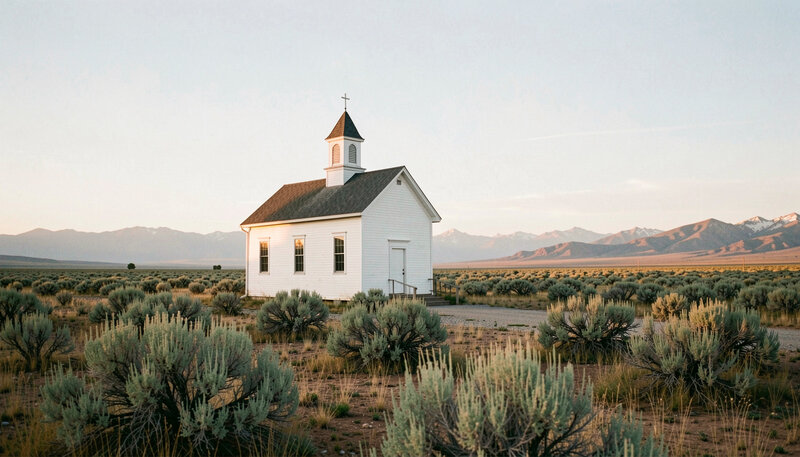
Baptist work in Wyoming is a story of distance, railroads and stubborn congregations. In a state where towns are hours apart and the population of the whole territory, in the early years, would not have filled a modern suburb, Baptist churches organized anyway, first through the Northern tradition and later through a Southern Baptist expansion that reshaped the map. This page traces that history plainly: where the churches came from, how they cooperated across the distances, and what the network looks like today.
The first Baptist generation: missions on a frontier
The earliest Baptist presence in Wyoming arrived with the settlers and the Union Pacific. Home missionaries in the territorial years planted preaching points along the rail corridor, and congregations gathered in Cheyenne, Laramie and the towns the railroad made. These first churches belonged mostly to the Northern Baptist tradition, the stream that became the American Baptist Churches, and they carried its instincts: congregational self-governance, associations for mutual help, and an allergy to hierarchy. A town like Worland, founded around the Big Horn River in the first years of the twentieth century, fits the pattern exactly, its First Baptist Church organized in 1906, sixteen years after statehood, and that congregation's own story is told separately on the FBC Worland history page.
Two traditions, one sparsely populated state
For most of the twentieth century, Wyoming's Baptists lived in two parallel streams. The older Northern-descended churches dotted the older towns, while Southern Baptist work grew later, carried west by migration and by deliberate missionary strategy after the Second World War, when the Southern Baptist Convention turned its attention to the western states. Southern Baptist congregations multiplied through the second half of the century, often in the same towns as existing Baptist churches, worshiping in rented halls, storefronts and new buildings. The result, unusual to outsiders, is normal to Wyoming: several Baptist families in the same small town, related by conviction and history rather than by organization.
The state convention and the work of cooperation
Southern Baptist churches in the state organized for cooperative work, eventually as the Wyoming Southern Baptist Convention, the name under which the network was long known, and today as the Wyoming Southern Baptist Mission Network, headquartered in Casper. The network gathers roughly one hundred churches into three regions, Northeast, South and West, an arrangement that acknowledges the plain geography: a church in Newcastle and a church in Evanston are closer to other states than to each other. Cooperation at this scale buys what small churches cannot build alone, leadership training, church planting support, youth camps and a shared insurance and screening infrastructure that a fifty-member congregation could never maintain by itself. The practical value of that shared machinery to a small church today is discussed in the ministry resources overview.
Mountain Top Baptist Assembly
The network owns and operates Mountain Top Baptist Assembly, an encampment center that serves as the physical anchor of cooperative life. Camps like it carry an outsized share of western Baptist history, because in a state of long drives they are the one place a church's teenagers meet the teenagers of forty other churches in a single week. Summer youth camps, leadership retreats and family gatherings held there have knit generations of Wyoming Baptists together across congregational lines, and many a small church's youth ministry, of the kind described in how to build a youth ministry, counts one week of camp as the high point and the recruiting ground of its whole year.
The Association-era instinct: what small churches share
Beneath the organizational history sits an older pattern that never changed. Baptist polity keeps the local congregation autonomous, so every layer above the church, association, state network, national convention, exists because churches choose to pool efforts, money and standards. In Wyoming that choice is more visible than anywhere: the distances make cooperation expensive, and the churches cooperate anyway, because the alternative is every congregation trying to fund camps, training and missions from a handful of families. The volunteer-and-share instinct that built the network is the same one this site documents at the congregational level, in the volunteer guide and the shared-event practices of church activities.
Worland in the wider picture
Worland's own Baptist story mirrors the state's. A 1906 American Baptist congregation serving a ranch and farming town on the Big Horn, growing with the community, building in brick at mid-century, and then, in 2003, voting to affiliate with the Southern Baptist Convention, one of many Wyoming congregations that made a similar move as the two traditions' demographics shifted in the state. Seventeen years later that congregation merged with its Southern Baptist counterpart across town, and the combined church continues today under a new name. The full record of those years, buildings and decisions is kept at the FBC Worland history page, which also explains this site's relationship, or rather its lack of one, to the congregation that now meets in the building.
Why a practical site keeps history pages
A magazine about running ministries might seem an odd home for denominational history, but the two are the same subject at different zoom. The practices this site documents, shared camps, screened volunteers, cooperatively insured vans, associations lending equipment, are the direct descendants of decisions made by Baptists crossing Wyoming in the last century and a half. Knowing where the machinery came from is how a church avoids treating it as magic, and why the history section sits beside, and feeds, the working guides of Bible study, student ministry and the rest of this site's library.