Section 3 · Church Life
Church Activities and Volunteers
Guides for the practical side of church life: recruiting and screening volunteers, planning events, retreats and activities people actually attend.
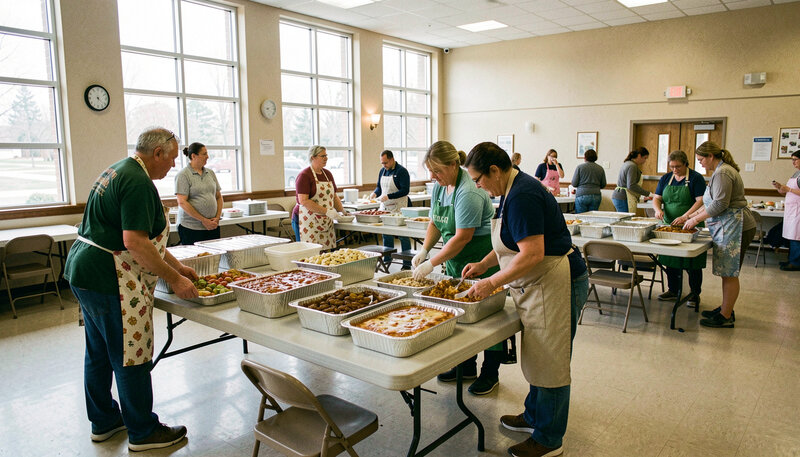
Church activities are the visible surface of a congregation's life: the dinners, the retreats, the workdays and the holiday events that people remember long after sermons blur together. Behind each of them stands the same quiet machinery of volunteers, planning calendars and safety basics, and that machinery is what this section of The Fellowship Hall documents. The guides here are written for small congregations where the person planning the event is also stacking the chairs afterward.
What this section covers
Two guides carry the section, one for each side of the coin. The Church Volunteer Guide covers the people machinery: recruiting without guilt trips, screening the people who serve minors, onboarding that actually prepares someone, and the practices that keep volunteers healthy enough to stay for years. Church Events and Activities covers the calendar machinery: which event types are worth a small congregation's energy, and the planning and safety basics for retreats, service days and trips away from the building.
Why the people and the calendar cannot be separated
Event planning fails most often not on logistics but on the assumption that bodies will appear. In a small church every event is staffed by the same forty people who staff everything, and every new event competes for their evenings. The planning question that matters is therefore not "what would be nice to offer" but "what do we have the team to carry well". A church that plans three events its volunteers can run with energy will outserve a church that plans ten and exhausts the crew by Easter. The volunteer guide's sections on load and burnout exist precisely for this calculation.
The weekly events that quietly carry a church
Between the big events sits the weekly rhythm that actually forms a congregation: the shared meals, the youth group night, the home groups described in the small group guide, the prayer meeting with five faithful attendees. These regular events deserve the same care as the visible ones, because they are where relationships compound. A useful discipline is to review the weekly calendar once a year as a whole, asking of each recurring item who it serves, who carries it and whether it still earns its slot, rather than letting the calendar accrete by inertia.
What makes an event worth the effort
The test of a church event is not attendance but connection: did people who barely know each other talk longer than a hallway minute. Events that pass the test reliably share features: food, a task or structure that mixes people rather than leaving them in their existing clusters, an ending that is not rushed and a follow-up that names what comes next. Events that fail usually fail on the ending or on the follow-up, leaving warmth to evaporate before the next Sunday. The events guide walks through the main types, dinners, retreats, service days and trips, with the specific planning questions each one raises.
Where to find help for the carrying
Small churches do not have to invent their event machinery from scratch. Denominational bodies publish child safety standards and camp directories; regional associations often lend equipment and train leaders; and the tool side of modern planning, scheduling apps, shared sign-up sheets and group communication, is surveyed in the resources section. The Fellowship Hall's own history pages also trace how congregations in ranch country organized these same rhythms with far less infrastructure, a reminder that the machinery is older than the apps: see Baptist churches in Wyoming.
Start with the team you have
If the volunteer side is the current bottleneck, read the volunteer guide first and fix the recruiting and care machinery before adding a single event to the calendar. If the team is healthy but the calendar is stale, start with the events guide's inventory exercise and cut before adding. Either way, the section index you are reading is the map, and each guide ends with steps small enough for one person to take this week.
The annual rhythm of a small church calendar
Most congregations run on the same quiet seasonal wave, and planning with it beats planning against it. Fall launches with recovered energy and carries the back-to-school momentum into new groups and the first big meal. Advent and Christmas concentrate December into services rather than events, and January is for recovery and restarting rhythms rather than innovation. Lent and spring carry the retreat season, when winter has closed in and a weekend away actually means something, and the school year ends with a celebration rather than a fizzle. Summer thins attendance and hands the calendar to the simple things, park evenings, ice cream after a service, a midweek that moves outside. Writing the year onto that wave takes an afternoon and saves a hundred small negotiations.
What to do when an event fails
Failed events are tuition, not disasters, provided the church collects the lesson. A failure review answers three questions in writing: was the idea wrong for this congregation, was the timing wrong, or was the announcing wrong, because those three have different remedies. An idea wrong for this people should not return dressed differently; a timing failure reschedules; an announcing failure fixes the channel rather than the event. Congregations that skip the review repeat the failure in two years, since the committee will have turned over and nobody will remember why the idea smelled familiar. Keep the review with the event records described in the events guide, and the institutional memory survives its holders.
The hospitality floor beneath everything
Underneath every activity in this section sits one common skill: making a room work for a stranger. Someone at the door who greets by name, a chair brought over rather than pointed at, food that includes the allergies anyone mentioned, an introduction made between the newcomer and the one member they will actually click with. Churches that do these four things reliably fill their events with returning guests, and churches that do them poorly wonder why publicity does not work. The floor costs nothing and is the single highest-return investment in the entire activities calendar.
Guides in this section
Church Life
Church Volunteer Guide
Recruit by invitation, screen by policy, onboard in three shifts, keep for years.
Church Life
Church Events and Activities
Dinners, service days, retreats: which events earn their calendar slot.