Section 2 · Bible Study
Small Group Bible Studies
How to run a small group Bible study that lasts: the right size, a repeatable evening shape, honest questions and how to handle dominant talkers.
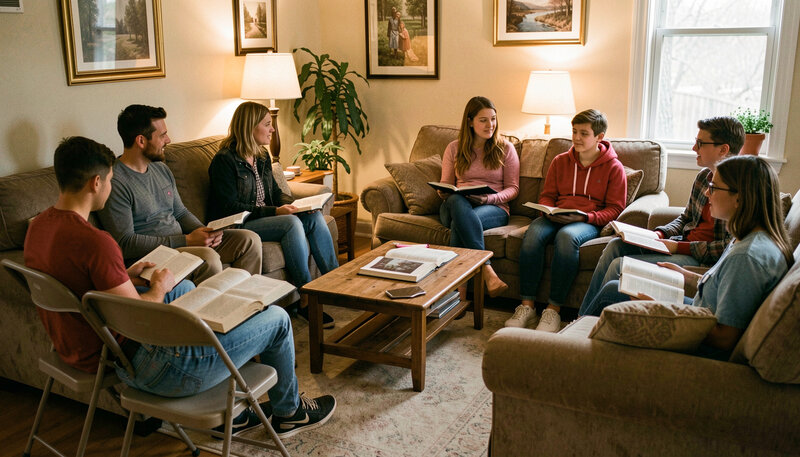
Small groups are where a congregation does most of its actual formation, one living room or classroom at a time, and they live or die on working details rather than teaching brilliance. A group that meets in a warm room, starts on time, asks honest questions and ends when it says it will outlast a dozen groups with better curriculum and colder coffee. This guide covers the operational craft of a durable small group Bible study: size, the shape of an evening, the questions that keep a circle honest, and the people problems every group eventually meets.
What size does a group need to be
The working size for a discussion group is five to ten people. Below four, one absence changes the group's character and the conversation runs out of angles. Above twelve, the room stops being a circle and becomes an audience, because people speak to the group rather than to each other. When a group grows past twelve, the healthy move is to plant a second group rather than to keep growing the first, ideally with a co-leader who has been quietly apprenticing for a season. A congregation of a hundred can run a dozen such groups, which is more ministry surface than any lecture format can reach.
The repeatable shape of an evening
Durable groups run the same simple shape every time, which lowers the energy cost of attending. Food and arrival for the first stretch, with conversation that is genuinely about the week. A short opening, one reading, done well aloud rather than rushed. Discussion built on a handful of questions rather than a worksheet. A closing that names prayer needs plainly and ends at the promised time. Ninety minutes total is the ceiling for most working adults; groups that drift to two and a half hours shrink to the members with the freest schedules, which quietly reshapes the group without anyone deciding it.
What makes a question work in a circle
The questions that carry a group are open, specific and safe to answer badly. Open, because yes-or-no questions harvest nods. Specific, because "what struck you in this passage" reaches further than "what does this mean to you" a hundred times removed from the text. Safe, because a circle where an honest answer gets corrected in front of everyone teaches caution by the third week. Leaders should hold a question in reserve for each stage of the evening: one to open, two to deepen, one to land. The fuller catalog of question types, including the ones that work with teenagers, sits in the study ideas guide.
How do you handle the member who answers everything
Every group has a talker, and the group's health depends on how the leader handles them rather than whether they exist. Private conversation works better than public suppression: thank the talker for their engagement, name the goal of hearing everyone, and give them a role that uses their energy, such as tracking prayer requests or drawing out the quieter members. In the moment, body language does quiet work: receiving the answer with a nod and then turning physically to the other side of the room. Seating the talker beside the leader rather than across the circle also lowers their share of the airtime, for reasons nobody fully understands but every group leader confirms.
And how do you lift the silent member
Silence in a circle has several causes, and only one of them is shyness. Some members are processors who speak once, well, near the end; the leader's job is to leave enough silence for that contribution to arrive. Some are new and testing whether the group is safe, which takes three or four meetings. Direct spotlighting, asking the silent member to answer the hard question, reliably backfires; better to ask them something within their certain knowledge early, such as reading the passage or telling a small piece of their week, and let the bigger speaking come when it comes. A group where the silent member returns is a group that worked.
The habits of the host
The host of a home group carries more of the ministry than the teaching plan does. The craft is mostly hospitality: chairs in a circle rather than a sofa row, light that flatters nobody's tiredness, coffee that is actually hot, a start that honors the people who arrived on time. The host also guards the group's confidentiality, which is the currency of honesty, and its calendar, sending the reminder, confirming the next date, noticing when a member has missed twice. These are exactly the reliability traits that make someone worth recruiting in the first place, which is why the volunteer guide treats group hosting as a core ministry role rather than a favor.
Where groups and youth ministry connect
A church's small groups and its student ministry share muscles. The question craft is identical across ages; only the container changes. Teenagers who learn circle habits in a youth group step naturally into adult groups after graduation, and students ready to help lead a discussion circle are being groomed, in effect, for the church's next generation of group leaders; the handover path is described in raising student leaders. Meanwhile the adults who host groups model for the whole congregation the kind of unhurried attention that teenagers also respond to when adults bring the same patience upstairs to the gym.
Keeping a group alive across the year
Groups sag in predictable places: after the holidays, at the end of the school year, and whenever the study runs two weeks longer than its natural life. Plan the calendar in terms with breaks between them, and let a term end with a meal rather than a lesson. Recruit an apprentice leader every year or two so the group can eventually multiply without mourning. And when a group genuinely ends, because members move or life changes, let it end well and on purpose, with gratitude named out loud; a church that knows how to close groups gracefully opens new ones without fear, which is the whole rhythm described across church activities.